CMA-ES System Identification for Sim-to-Real
Extending a quadruped actuator-ID pipeline (PACE) to a bipedal humanoid
Robotics
Overview
Domain randomization closes the sim-to-real gap by covering it with a wide distribution of dynamics parameters — which also pushes the learned policy toward being overly conservative. The alternative is to estimate the dynamics parameters that actually match the real robot, then randomize around that narrower, calibrated point. I built a CMA-ES–based system identification pipeline, extending PACE (originally designed for quadruped actuators) to a single actuator on a bipedal humanoid platform, and further extended the search from joint-level parameters to link-level ones — CoM and mass — which matter far more for a biped's whole-body dynamics.
Pipeline
1 — Objective design: what to fit, and on which data
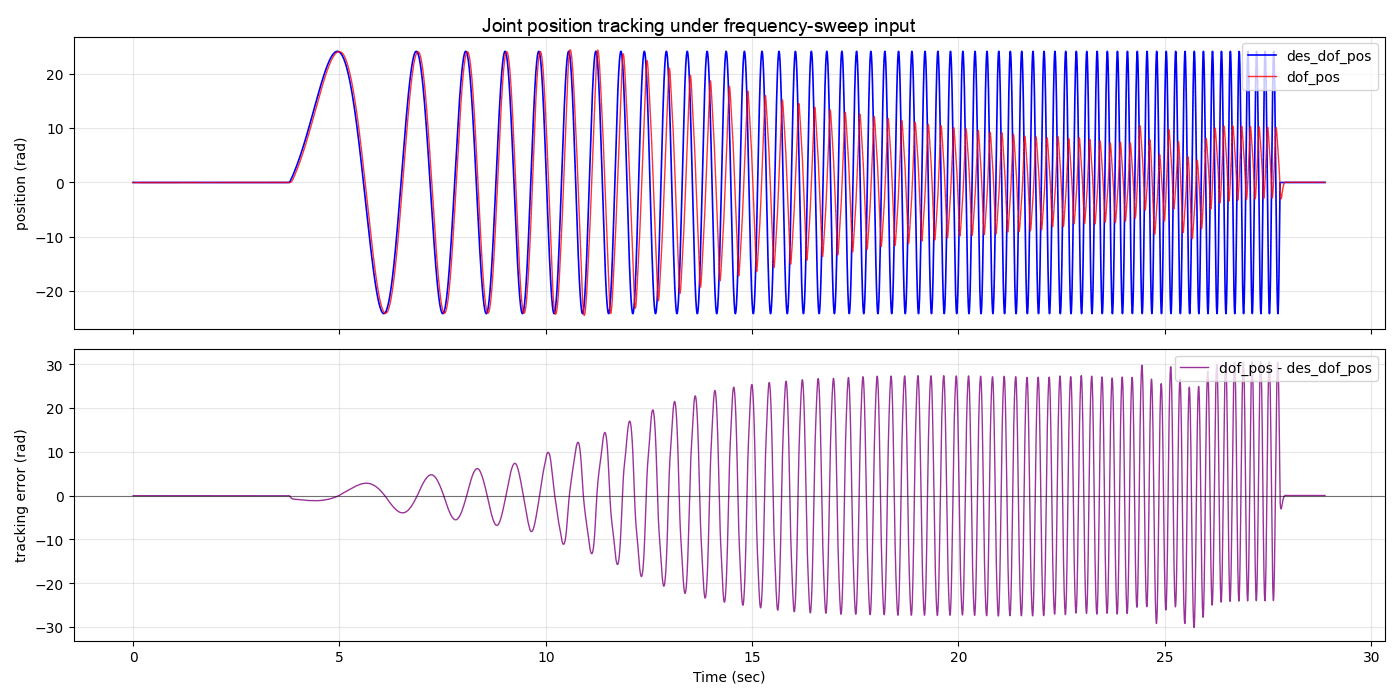
A frequency sweep on the real actuator shows tracking error growing monotonically with excitation frequency — I used the segments where dynamics are most clearly expressed as the fitting input, rather than the full trajectory.
The fitness function combines trajectory-tracking error with an armature regularization term:
J(θ) = Σ_t ‖ q_t^sim(θ) − q_t^real ‖²  +  λ ‖ a − a_nom ‖²

θ = [a, d, f]     armature · damping · friction, 3n dims for n joints
a_nom             nominal armature from real measurement (the only ground-truth term)
λ                 regularization strength; damping/friction have no nominal, so are excluded
Problem: once the search space was widened to link-level parameters, CMA-ES converged toward minimizing trajectory error alone, drifting the armature to physically implausible values (overfitting the objective rather than the physics). Fix: every generation's candidate is penalized by its L2 distance from the measured nominal armature — a ridge-style penalty that keeps the optimum anchored near the physically measured value.
2 — Fitting result
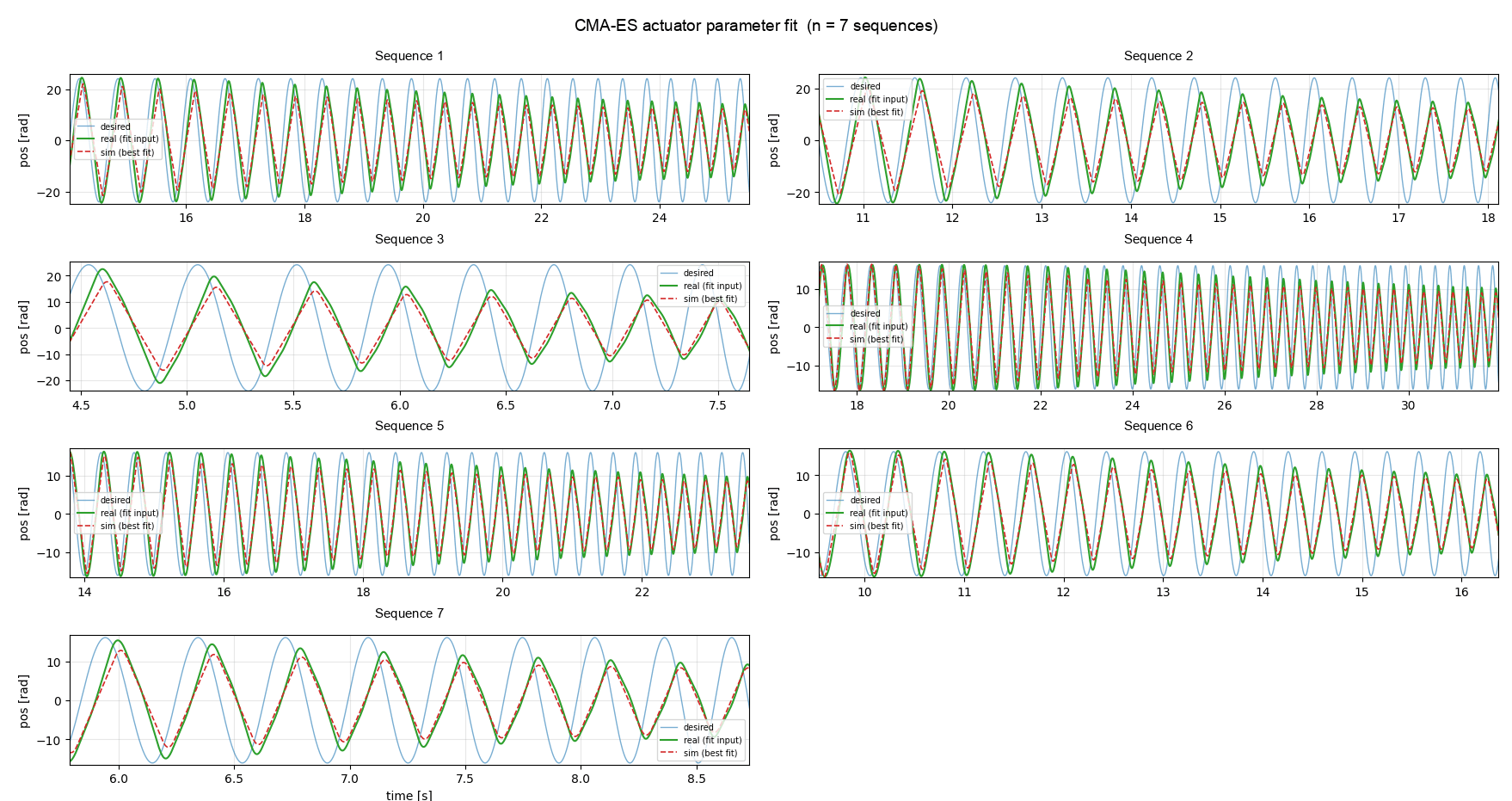
- Convergence. All 7 sequences — spanning different excitation frequencies and amplitudes — converge to the same order of trajectory error.
- Interpretation. The desired command shows a clear phase lag and amplitude decay relative to the real actuator response; the fitted simulation reproduces that same lag and decay, meaning the simulator now tracks the actuator's real response rather than the ideal commanded one.
Result
The pipeline produces a dynamics-parameter estimation workflow for single-actuator, bipedal-humanoid platforms, with visual and quantitative validation of the improvement in real-trajectory tracking — used as the calibrated domain-randomization center for the locomotion policies trained on top of it.